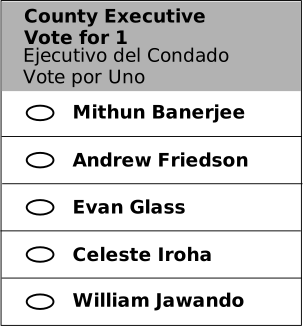
As of this writing, there are five candidates chasing the Democratic primary win for county executive: Will Jawando, Evan Glass, Andrew Friedson, Celeste Iroha, and Mithun Banerjee. This guarantees that nobody will win a majority vote. Let’s get into the details.
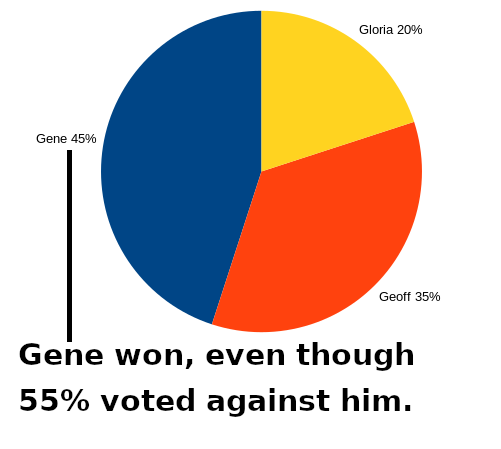
The “winner” of our local primary elections is the one who accumulates the most votes, not a majority of votes. For example, Gene, Geoff and Gloria run for office. On election night, Gene wins 45% of the vote, Geoff 35%, and Gloria 20%, so Gene is the winner—even though more people voted against him than for him.
Montgomery County has an overwhelming preponderance of registered Democratic voters, and there has not been a Republican or independent County Executive for at least 40 years. Both history and political theory indicate that whoever wins the Democratic primary for county executive will also win the general election against a Republican candidate. This reality makes the Democratic primaries so critical. Again, these calculations are quite common throughout the United States, Republican and Democratic jurisdictions alike.
My guess is that the winner of the primary will be one of the three sitting council members: Jawando, Glass, or Friedson. While we certainly wish the best for the two other candidates, they currently don’t have the political infrastructure to pull off a win.
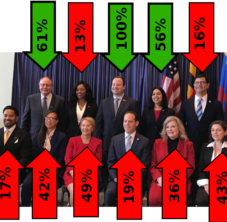
Jawando, Glass, and Friedson appeal to different demographics, none of which represents a majority of the Democratic electorate. Therefore, it is a very safe bet that whoever wins the Democratic primary will not have a majority. If, for example, Jawando wins with 40% of the vote, 60% of the Democrats voted against him. That is an unconvincing win.
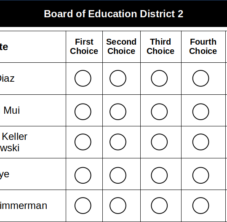
Enter runoff elections. We hear of runoff elections in Europe and occasionally in parts of the Anglosphere. They aren’t entirely foreign to Montgomery County. We have runoff elections for the Board of Education. In the primary elections we select the top two vote-getters in a district, and they face off in the general election.
One protocol for runoff elections is ranked-choice voting. These are automatic runoffs that do not require voters to appear once again at a polling station. Evan Glass has previously expressed support for RCV, as have some Annapolis legislators.
Runoff elections, in the form of RCV or otherwise, are a must if we are to convince ourselves that the winner of the Democratic primaries (for county executive and any other office) indeed received a majority of votes. Without that legitimacy, the winner is beholden to the small demographic that elected it. That makes all of us losers on election night.