
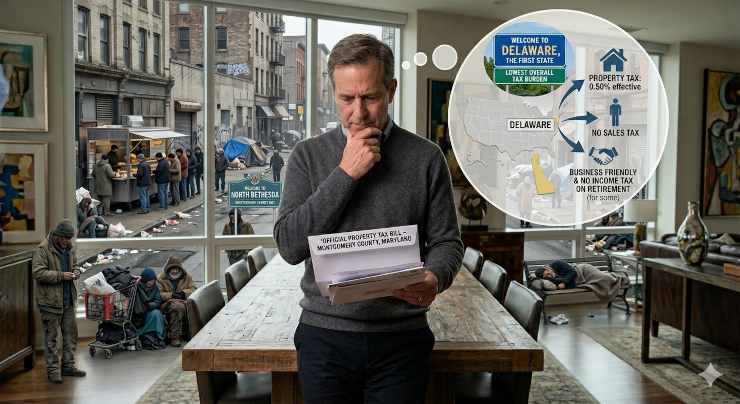
If you were standing on a cliff watching others jump to their deaths, would you follow?
Common sense says no. Yet Montgomery County is poised to do exactly that, repeating policies that have already failed elsewhere.
This year’s proposed 5.5% expansion of the county budget comes with a steep cost: a 6.3¢ per $100 increase in the property tax rate, translating to roughly a 14% spike in property tax bills per the March 23, 2026 Montgomery Perspective article. The public backlash has been swift and justified. In response, some council members are retreating from the property tax hike, not by reducing spending, but by shifting the burden onto “the rich.”
That may sound politically convenient. It is not economically viable as a the long term solution.
We’ve seen this story before. In 2018, Sage Hill Consulting warned that Montgomery County’s fiscal path was “unsustainable.” Even then, the county had already created a climate that pushed major employers, and their tax revenue, elsewhere, particularly to Northern Virginia. Without a strong business base, the cost of government shifted heavily onto residents.
Instead of correcting course, county leadership has doubled down.
Look at what’s happening in places that have taken this approach further like parts of California, Chicago, Seattle, New York. These jurisdictions didn’t start out struggling; many were economic powerhouses. But as tax burdens rose and policies grew more hostile to businesses and high earners, those taxpayers did what they are uniquely able to do: they left.
When they leave, they don’t just take their income, they take jobs, investment, and a disproportionate share of tax revenue. The result is predictable: a shrinking tax base, persistent inequality, and mounting fiscal strain. The very people these policies are meant to help—the underserved—end up with fewer resources, not more.
Why should Montgomery County expect a different outcome?
“Taxing the rich” puts even more weight on an already narrow slice of taxpayers. That’s not a safety net, that’s a balancing act on a fraying wire. And make no mistake: many high earners are already running the numbers, asking whether staying makes financial sense.
There is a better path, but it requires discipline. Sustainable budgeting isn’t about punishing success or chasing politically easy targets, it’s about aligning spending with reality. It means prioritizing, making trade-offs, and ensuring that commitments today don’t undermine the county tomorrow.
If the goal is to protect the underserved, the worst thing we can do is drive away the very tax base that funds essential services. Fiscal responsibility isn’t austerity, it’s stewardship.
Montgomery County is at a crossroads. Continue down a path that others have taken—with clear, negative results—or choose a more sustainable course that protects both the county’s finances and its most vulnerable residents.
The choice shouldn’t be difficult.
Related posts:
 Montgomery County’s “Tree Canopy Law” is Having Consequences Each and Every Summer – and Making “Tree Expert” Companies Very Rich
 Investor Beware: MoCo Govt Issues More General Obligation Bonds as ‘Debt Servicing’ Projects
 Economic Storm Clouds Are Gathering, But the Montgomery County Council Seems Pre-Occupied with Other (National) Topics