
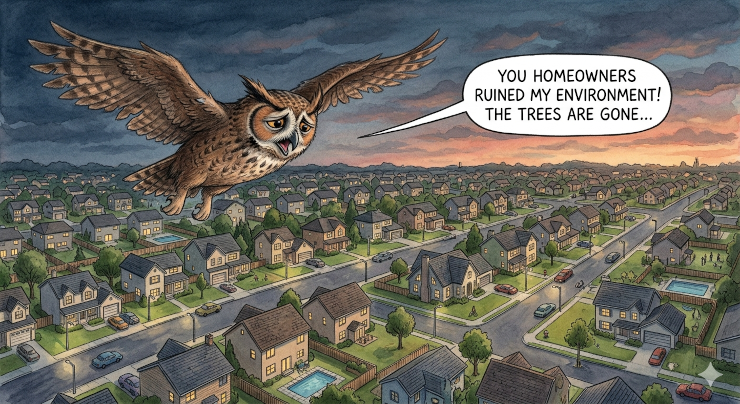
A few months ago we had a winter fair at our neighborhood elementary school that gave us a much needed excuse to get out of our snowbound homes. Those in attendance were elementary schoolers, pre-schoolers, their parents, and a few grandparents.
Also in attendance were volunteers from a local wildlife rescue and rehabilitation organization. The falconers were explaining the habits of our local eagles and owls. Watching a falconer handle birds of prey exerting 400 psi of strength in their talons is daunting.

The falconer was explaining the challenges our local raptors face. In particular, and quoting from memory, the falconer dropped this bombshell in front of those innocent, wide-eyed children:
“Much of the damage to the birds’ habitat is due to developers.”
No doubt many other people believe this, and also believe that developers cause traffic congestion, excess load on infrastructure, school crowding, ruin everyone’s lives, and are the reason for a 4.3% chance that asteroid 2024 YR4 will collide with the moon.
We need to get back to basic economics. Developers, as any entrepreneur, do only one thing: what their customers want them to do. They do not get up in the morning and think, “What is the fastest way I can cause a bee colony to collapse.” What they do think is, “Folks are looking for a new neighborhood of townhouses, so we’ll break ground north of Olney.” Intrusion on an owl’s environment is a direct result of the homeowners’ desires, not the developers’ actions.
In fact, there are plenty of people to blame for intrusion on wildlife habitat: homeowners, planning commissioners, mortgage financiers, boards of education, first-responder agencies, and the developers. If you remove any of those actors, a housing development goes defunct and the owl keeps its nest. The only people who are blameless for the deteriorating environment are the homeless living in bus shelters.
Developers are not the reason wildlife goes extinct, and teaching children that they are denies those children an opportunity to develop critical-thinking skills.
Related posts:
 A MoCo Developer’s Solution for Affordable Housing
 Community Profile: A Charter School Comes to Montgomery County—Interview with LaChaundra Graham
 MCPS Says There is Still a “Critical Shortage” of Speech Pathologists in Discussion Between Longview Elementary Community / Parents, MCPS Office of Special Education