There is no such thing as a “bad” doughnut. Go to the beloved Donut King in Kensington and try to find one.
In contrast, there is definitely a difference between good and bad public debt.
In a recent meeting at Poolesville’s city hall, Council Member Will Jawando promoted the possibility of the county taking out more loans in the form of “good debt.” The implication in his remarks is that good debt will not raise taxes.
Such promises do indeed come true. After World War II, municipalities took out loans to finance infrastructure in the sizzling suburbs. For example, in the 1960s Montgomery County issued general obligation bonds to build Churchill, Einstein, Walter Johnson, and Kennedy High schools. Similarly, debt was issued to upgrade Seven Locks Road, Pooks Hill, and Montrose/Randolph Road. This debt was issued in anticipation of the county’s population increasing from 340,000 to over 520,000 in the same decade—averaging 18,000 residents per year.
That was then, this is now, and there are four primary differences.
a) From 2020 to 2025, the county grew from 1.06 to 1.07 million residents, an anæmic 1% increase in five years (2,500 residents per year).
b) The new residents are primarily immigrants from foreign lands. While we welcome all, we must also realize that these residents are not necessarily forming the same tax base as did the highly paid workers hired under the Johnson and Nixon expansions.
c) The schools are in place, as are the roads, hospitals, and water lines.
d) We don’t know the nature of the emigration. How many of the émigrés are affluent retirees and remote workers moving to less burdensome jurisdictions?
In short, given the current population, very little infrastructure needs to be installed. Our existing infrastructure needs to be maintained or possibly retired.
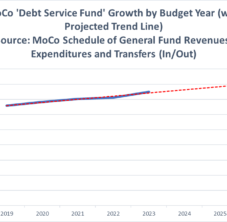
Loans for maintenance are not “good debt” because they contribute little to attract a high-income tax base needed for repayment. In fact, such loans invariably raise the tax burden on remaining residents in jurisdictions that are losing a vibrant tax base. What’s worse, as the debt burden increases, the county’s premier AAA credit rating may decline, causing an even greater debt burden.
Montgomery County needs to keep its spending in line with what the population can afford. Join the ballot initiative to limit tax increases. Go to Stop the Spend and sign up to be a volunteer or contributor.