We’ve previously introduced Maria and Juanita: one an irresponsible alcoholic parent, the other a local version of Mother Theresa. I overheard them having a discussion at the Fort Totten Metro stop.
“Maria,” said Juanita, “I’m not able to take care of your grandmother any more.”
“Why not?” asks Maria.
“Well, as you know, I travel two hours each way to get to her house. I wash her piled up dishes and laundry, check her vital signs, do cognitive evaluations, and make sure she has enough supplies until the caregiver arrives.”
“Yes, I’m aware you do all that. You’re supposed to do that.”
“Well, Maria, I can’t do it any more. I now have other priorities. I have to take care of my own close relatives. Maybe you can start taking care of your own grandmother.”
“You are a horrible person, Juanita. I hate you.”
Ethicists, pastors, and dour utilitarians will tell you that at a minimum Maria needs to thank Juanita for showing her past kindness. They will also tell you that the moral responsibility for taking care of Maria’s grandmother lies far more with Maria than with Juanita. The fact that Juanita set a precedent by caring for Maria’s grandmother does not obligate her to do so in perpetuity.
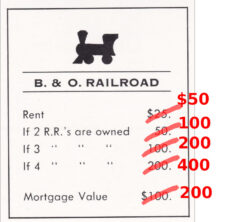
Let’s apply that thinking to the reality that the federal government is cutting back on Medicaid, health insurance, and SNAP subventions to the states.
Discussion number one is if the federal government should be subsidizing state-level benefits in primis. Perhaps at one time that was a digestible arrangement. Today, given the nation’s frayed identity, it’s difficult to insist that residents of deep-red Wyoming, with only $2 million in outstanding state debt, subvent hallucinogenic deep-blue Californians with $520 billion in state debt (source). Similarly, to cover these programs’ expenses, the federal government needs to borrow a whole lot of money. Should Americans not yet born be forced to pay the loans to cover benefits of today? Even worse, as the United States’s credit rating continues to deteriorate, that future burden will be ever worse and ever more unfair. Personally, I think federal subsidies to state poverty programs were an a priori mistake, and a century of reckless federal spending and budget deficits on these and other far more frivolous programs are strangling everyone’s future—affluent and impoverished alike.
Our public officials’ reaction has been predictable. Senator van Hollen condemns the federal budget, and Congressman Raskin called the budget a big, wretched, abominable bill. Evan Glass has been a bit more constructive, asking in 2023 that the state government foot the bill for previously reduced SNAP benefits (although that still puts the responsibility for tending to MoCo’s poor on the state government). None of this is productive or ethical. MoCo, and nobody else, is responsible for caring for MoCo’s struggling residents.
Does that mean absent federal SNAP programs our county’s poor must go hungry? Hardly. Those of us who really care about the underserved realize that the federal largesse is done and gone, and that deploying the safety net is now our job. In the next installment of this series, we’ll see that MoCo can easily make up a hypothetical cancellation of the federal SNAP subvention.