A growing number of County residents and community groups are speaking out against the “More Housing N.O.W.” legislation, specifically Zoning Text Amendment (ZTA) 25-02 scheduled to be taken up by the County Council in July. Some Council Members are promoting the bill as a step toward increasing affordable housing options for teachers, firefighters, nurses, and other essential workers, but critics argue it may do more harm than good by displacing current residents, putting a strain on already burdened public services, and actually making housing more expensive.
According to opponents such as Kim Persaud, founder of EPIC, Empowering People in Communities of MoCo, ZTA 25-02 will lead to the demolition of naturally-occurring affordable housing (NOAH) along more than 25 transportation corridors, including Georgia Avenue, University Boulevard, Randolph Road, and Veirs Mill Road. These areas are home to working-class families, immigrants, and long-time residents living in modest single-family homes, duplexes, and garden-style apartments.
Under this rezoning measure, developers will be allowed to link multiple adjacent lots—even those that wouldn’t qualify on their own—to create large development parcels. These linked properties can be replaced with bigger, more expensive duplexes, triplexes and small apartment buildings without any mandate to include affordable units. This, critics say, would make communities more dense and strain already-burdened infrastructure—impacting traffic, emergency services, and public schools.
“We support the goal of affordable housing, but this is not the way to do it,” said Rebecca Hanson, Co-President of the Westmoreland Citizens’ Association, a group of about 1,000 households located on both sides of the Massachusetts Avenue Corridor. “The legislation is being rushed through without sufficient study, consultation with community stakeholders, or a full master plan review.”
A key issue cited by critics is the exemption of duplexes from affordability requirements. Under the proposed rules, developers would be allowed to demolish existing single-family homes—often older, more affordable structures—and replace them with duplexes that contain two new units, neither of which is required to be priced affordably. In some cases, the resulting units are more expensive than the homes they replaced.
“This loophole benefits developers far more than working families,” another community member, Ann Telma, a long-time resident of Westmoreland Hills, stated. “It incentivizes profit-driven redevelopment without delivering on the promise of affordable housing.”
Rather than disrupt established neighborhoods, residents advocate focusing development on underutilized commercial areas such as the White Flint Mall site and the GEICO site in Friendship Heights. These locations, they argue, offer opportunities to build a high volume of true workforce housing without displacing current residents, overburdening public infrastructure, or disrupting established neighborhoods.
Opponents of the bill are calling for a pause in the legislative process and urge county officials to insist that ZTA 25-02 and related proposals undergo a full planning review, including broad stakeholder input.
“We’re not saying ‘no’ to housing,” Irv Lieberman, a long-time neighborhood homeowner and community advocate, concluded. “We’re saying ‘yes’ to doing it the right way.”
County officials have not yet responded to the growing call to postpone approval of this flawed legislation as it is currently formulated, but as opposition mounts, the debate over the future of housing policy in Montgomery County is far from over.
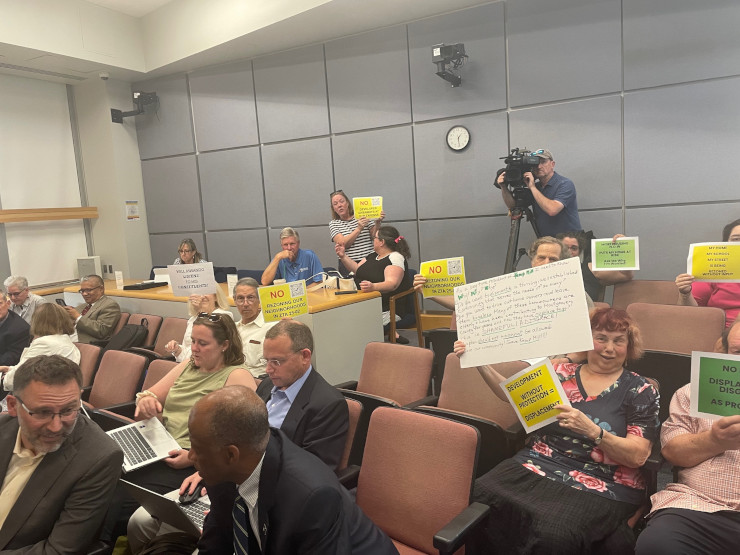
[Lead image: opponents of ZTA 25-02 at a recent Planning, Housing & Parks (PHP) session]